



When you hold your wealth as cash savings, it’s worth regularly checking whether your money is working as hard as it could be.
This is especially the case if some of your cash is in a current account rather than a dedicated savings account.
According to MoneyWeek, of the 86.3 million current accounts in credit across the UK in November 2025, 87% didn’t receive a single penny in interest.
The same source found that the average balance in static UK current accounts was £4,300.
Of course, it can be sensible to keep some of your wealth easily accessible for day-to-day spending or emergencies.
But leaving too much cash in an account that pays little to no interest could mean you miss out on valuable returns that help you achieve your long-term goals.
Similarly, it may be unwise to lock away all of your savings in a long-term fixed-rate account, especially if you think you may need to access some of it soon.
This is where “savings laddering” could be beneficial.
Read on to discover what savings laddering is and why it may help you balance access to your money with the potential to earn more interest.
Different types of savings accounts tend to offer varying amounts of interest
There are several ways to hold your cash savings, and each type of account tends to offer a different balance between interest and accessibility. Here are three.
1. Easy access savings accounts
An easy access savings account usually allows you to withdraw your money whenever you need it, making it a useful choice for an emergency fund or short-term spending.
However, since you have more flexibility, interest rates may be lower than fixed-term options.
Moreover, some easy access savings accounts might have variable rates, meaning the provider can change the rate of interest you receive whenever they see fit.
2. Notice savings accounts
Notice savings accounts may pay a higher rate of interest than an easy access account, but you typically need to give notice before withdrawing your money.
This might be 30, 60, or even 90 days, depending on the account.
3. Fixed-term savings accounts
Fixed-term savings accounts require you to lock your wealth away for a set period, such as one to five years.
In return, you may receive a fixed rate of interest for the full term, making them attractive if you want reliability and believe interest rates could fall in the future.
Of course, if you lock away your savings for several years and later need the cash for an emergency, you may not be able to withdraw it early.
If your provider does allow withdrawals, you could face a penalty that reduces the overall interest you can earn.
Savings laddering could help you balance access to your cash and returns
As you can see, part of the challenge with saving is finding a balance between keeping your money available when you need it and making the most of higher rates.
To solve this problem, you could employ savings laddering. This strategy involves splitting your savings across several accounts with different terms.
Rather than placing all of your cash in one account, you might divide it between easy access savings and fixed-term accounts that mature at varying times.
This could give you access to some of your cash when needed, while allowing your other savings to benefit from fixed, typically higher, rates for longer.
For instance, you could keep between three and six months’ worth of essential household expenses in an easy access savings account for emergency costs.
Then, you may decide to place the rest into one-, two-, and three-year fixed-term accounts.
As each fixed-term account eventually matures, you can then decide to withdraw the cash, move it to an easy access account, or reinvest it in another fixed-term account.
The table below shows how savings laddering might work if you had £50,000 in cash savings.
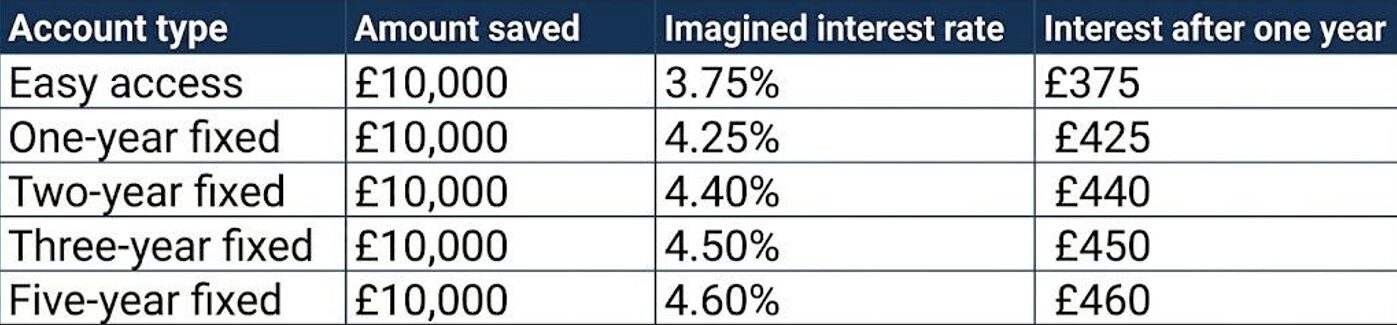
As you can see, savings laddering could allow you to hold on to some of your cash for immediate purposes, while still placing a portion of your savings in accounts to hedge against lower rates.
Interest rates tend to change over time, and laddering could help you manage this variation
Another notable benefit of savings laddering is that it may reduce the risk of committing all of your cash to a particular savings account at the wrong time.
Interest rates tend to change regularly, and varying accounts might become more or less beneficial depending on inflation and the base rate.
If you place all of your savings into a single long-term account, you may benefit if rates fall later down the line.
However, if rates rise instead, you could be left earning less than newer accounts offer.
Conversely, if you keep everything in an easy access savings account, your rate could eventually fall if providers reduce their variable rate.
Laddering could mean only part of your money is locked away at any given time, so as each account matures, you have the chance to review rates and decide whether to reinvest or withdraw.
This ultimately gives you more flexibility than choosing a fixed-rate account, while potentially offering more competitive returns than holding everything in an easy access account.
Investing might be more suitable for achieving your long-term goals
While savings laddering can be a practical way to divide your cash, it’s essential to remember that it still has its drawbacks.
Even if you do manage to secure a competitive rate, the interest you earn might not be enough to outpace inflation over the long term.
Inflation may reduce the real-terms value of your wealth because, if prices rise faster than the interest on your savings, the purchasing power of your money falls.
Cash tends to be more appropriate for emergencies or short-term goals since you need access to it sooner. However, if you’re saving for longer-term goals, such as retirement or helping children onto the property ladder, investing might be more beneficial.
MoneyWeek reports that the FTSE All-Share index managed to beat inflation in every 20-year rolling period between January 1988 and August 2025, while cash failed to do so in a quarter of cases.
Of course, it’s vital to note that investing always carries risk, and the value of your investments can rise as well as fall.
Still, it’s worth considering how much you need in cash and whether you could invest more of your wealth instead.
Get in touch
We could help review your savings and investments to ensure you have enough cash accessible for short-term needs while also giving your longer-term wealth the chance to grow.
Please get in touch to find out how our team of VouchedFor Top Rated planners could help today.
Please note
This article is for general information only and does not constitute advice. The information is aimed at individuals only.
All information is correct at the time of writing and is subject to change in the future.
Please do not act based on anything you might read in this article. All contents are based on our understanding of HMRC legislation, which is subject to change.
The value of your investments (and any income from them) can go down as well as up and you may not get back the full amount you invested. Past performance is not a reliable indicator of future performance.
Investments should be considered over the longer term and should fit in with your overall attitude to risk and financial circumstances.